 Bananagrams
A table with mixed ages
Updated September 4, 2026 · 3 min read
Seven-year-olds, teenagers and grandparents can share the same table, because the standard race is rated for ages 7 and up. Other titles on our shelf fit even wider age spans, while simple house rules help balance mixed groups.
The short version
- Select games like Big Letter Bananagrams or Appletters to fit the exact age mix at the table.
- Distribute 21, 15, or 11 starting tiles to each person depending on the total player count.
- Try non-spelling options like Cobra Paw or Gurms to remove reading speed from the contest.
- Adopt house rules like custom hand sizes or shared grids if you decide the table needs balancing.
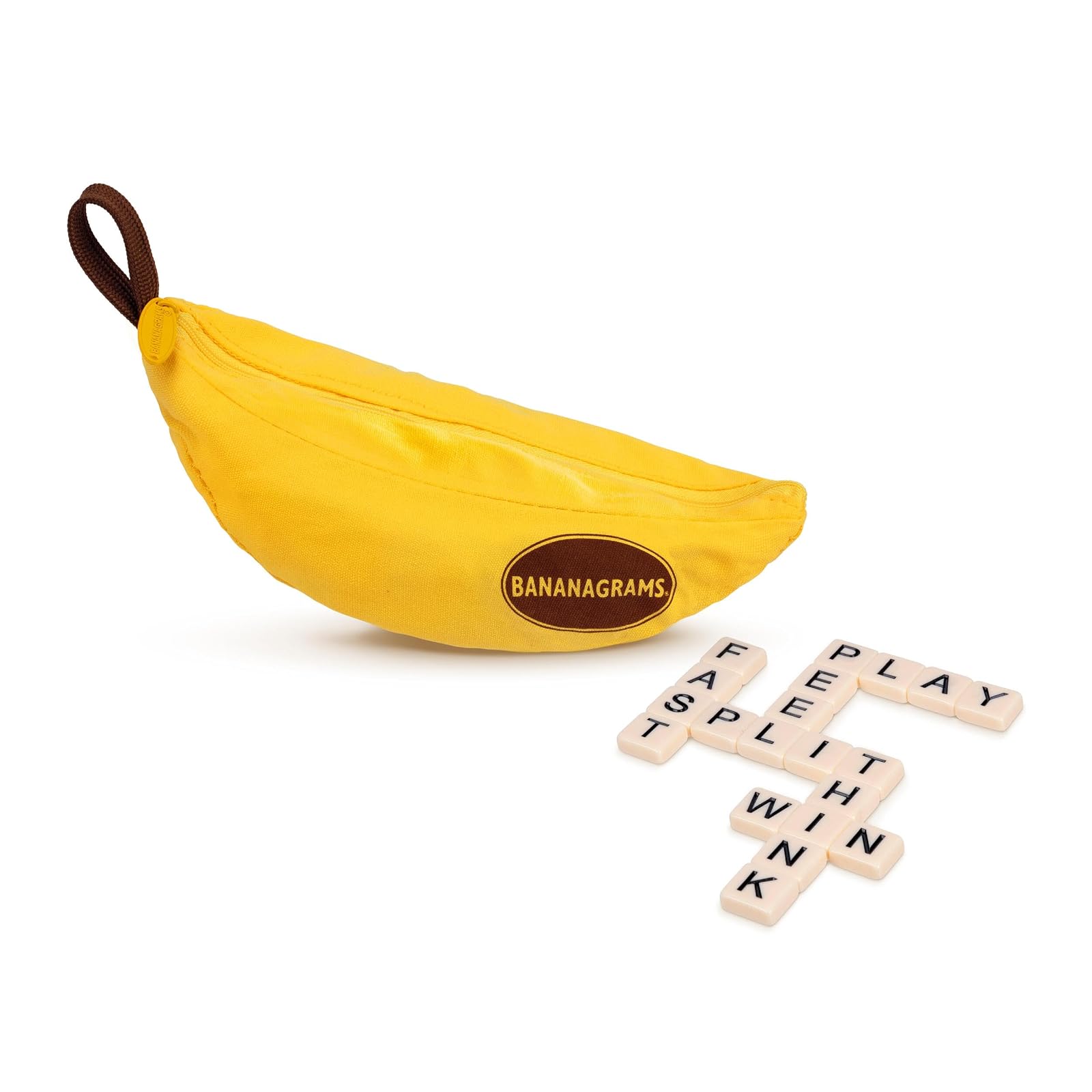
The classic game Bananagrams accommodates 1 to 8 players ages 7 and up. Everyone plays at once without turns. In games with 1 to 4 players, each person starts with 21 tiles. In games with 5 to 6 players, everyone draws 15 tiles. Tables of 7 to 8 draw 11 tiles each. Play begins when someone calls Split, and the race runs until the bunch holds fewer tiles than there are players, at which point an empty-handed player can call Bananas.
Different titles suit different mixes. Big Letter Bananagrams uses larger, higher-contrast tiles for players who need clearer visibility, while keeping the standard race rules. For groups with younger children, My First Bananagrams serves ages 4 and up with lowercase letters and 13 letter-pair tiles, while Appletters works for ages 5 and up as a turn-based game where players add letters to one shared worm.
Games outside the spelling line remove vocabulary gaps entirely. Gurms asks players ages 6 and up to match colors and symbols on creature tiles in turns. Cobra Paw requires no spelling, testing physical speed as 2 to 6 players race to grab matching stones after rolling two dice. The Furglars uses furry dice to catch Furgles for 2 to 6 players ages 7 and up.
When using the standard race with mixed ages, you can balance the table using house rules. You might decide to give a seven-year-old a smaller opening hand, disallow Dump for faster players, or let two players share a grid. These adjustments are not official rules found in the box, but house choices you decide on together.
The mistake to avoid
The mistake is to assume house rules are official rules printed in the box. Giving a player a smaller opening hand, forbidding Dump, or sharing a grid are choices you decide at your own table, not standard rules of the game.
Questions that keep coming up
What is the minimum age for standard Bananagrams?
The classic game is designed for ages 7 and up, accommodating 1 to 8 players.
Which shelf titles do not involve spelling words?
Gurms, The Furglars, Spiky Dastards and Cobra Paw contain no spelling. Gurms and The Furglars take turns, while Cobra Paw and Spiky Dastards are speed games.
How many tiles do players draw at the start of a mixed-age game?
Player count determines the draw: 21 tiles each for 1 to 4 players, 15 tiles each for 5 to 6 players, and 11 tiles each for 7 to 8 players.
Boxes that fit younger hands
We make these with the youngest player in mind, so nobody at the table sits out while the grown-ups spell.