 Bananagrams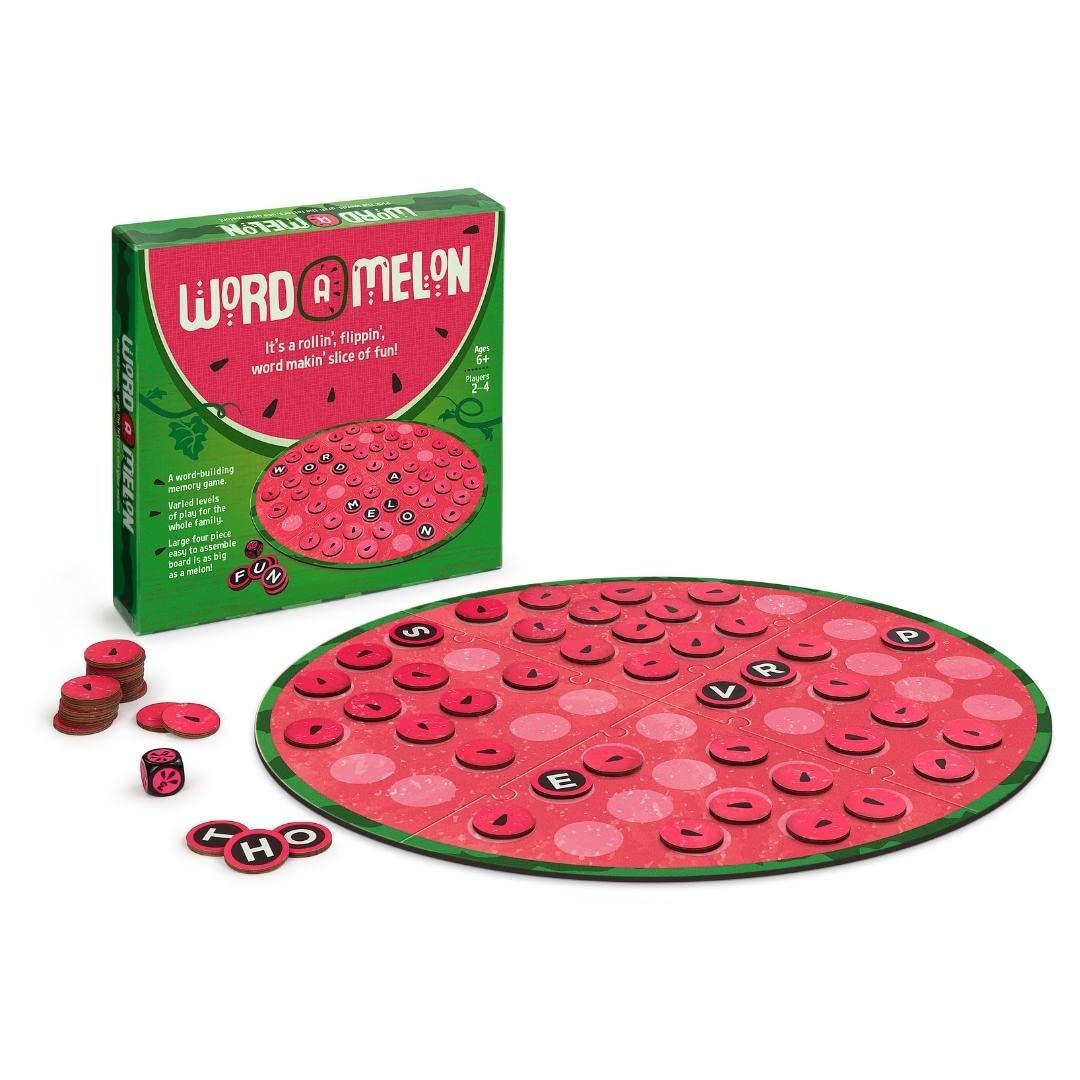
Word search that runs on memory
Word-a-Melon
Memory drives this hunt across the board, where flipped letter chips hide again if you cannot use them.
$16.57
Rated 4.6 out of 5 by 43 players
Roll the die and flip pink chips to find letters for a word. We place every piece face down on the watermelon board, so what you need sits hidden until somebody turns it up.
Watching other turns pays off when a needed letter appears and disappears in the same spot. You collect the chips you manage to spell with, and the biggest pile wins.
| Players | 2–4 |
| Ages | 6 and up |
| A game runs | About 20 minutes |
| In the box | Cardboard letter chips, a round board that assembles from four pieces, and a die |
| You also need | A table and a decent short-term memory. |
| The feel | Turns around the table |
How a game unfolds
Roll each turn
Roll the die to learn how many chips you may turn over.
Flip each turn
Turn chips face up and try to build a word out of what is showing.
Flip back the catch
Anything you did not use goes back face down, exactly where it was. Now remember it.
Most chips wins ends it
Words you make are yours to keep. The biggest stack at the end takes the game.
What makes it its own game
- Cardboard chips show black letters on pink faces across a round watermelon board.
- Die rolls set the number of face-down chips you may reveal on your turn.
- Unused letters flip back over in the exact spots where you found them.
- Spelled words leave the board entirely and become your personal scoring stack.
Worth knowing before you open the box
The spelling is the easy half. The hard half is that you saw a J four turns ago and cannot remember which chip it was under.
Who it suits
Adults often expect a deep vocabulary to win the game, but six-letter words mean nothing if you cannot locate the pieces. A player who tracks where vowels went will beat a player who only knows longer words. It fits mixed-age tables well because young eyes often track positions better than older ones. It does not suit anyone who hates tracking hidden pieces between turns.
Before your first game
Keep your eyes on the board during other turns instead of planning your own move in advance. Notice the letters people flip and put back down. Try to fix one or two vowel locations in your head early on. That mental map makes your own die rolls far more useful when your turn comes.
Elsewhere on the shelf
Still reading? That is usually a yes.
A word game that runs on memory: the letters are face down and you have to recall where they were.
$16.57